Field note · February 9, 2026
The Leadership Rhythm Framework That Prevents Burnout
By Todd McKeever
You have a routine. Morning coffee at 5:30 AM. Inbox review before your first meeting. Weekly team standup every Monday at 9:00 AM. You show up consistently. You execute flawlessly. You deliver results.
However, six months into this perfectly optimized schedule, something shifted. The routine that used to energize you now drains you. You are hitting all your marks but feeling none of the creative spark that made you effective in the first place. Consequently, you find yourself wondering if this is just what senior leadership feels like.
This is the difference between routine and rhythm. One kills you slowly. The other sustains you indefinitely. Therefore, understanding this distinction is critical for mid-career leaders who want decades of effective performance ahead of them.
Why Perfectly Optimized Routines Eventually Break You
I watched a senior pastor maintain the same weekly schedule for eight years. Sunday services. Monday prep. Tuesday meetings. Wednesday teaching. Thursday admin. Friday writing. Saturday family time. Similarly, his schedule looked like a model of discipline and consistency.
It worked brilliantly. Until it didn’t.
The structure that once provided stability became a cage. He was executing flawlessly while dying creatively. Moreover, the routine optimized for consistency had eliminated the variability his creative work required. As a result, his sermons became mechanical. His leadership became transactional. His impact plateaued.
Mid-career leaders fall into this trap constantly. You build efficient systems. You eliminate waste. You optimize workflows. Furthermore, you track metrics that prove your productivity is at an all-time high. Then you wonder why the work feels mechanical instead of meaningful.
The problem is not discipline. In fact, you have discipline in abundance. The problem is confusing routine with rhythm.
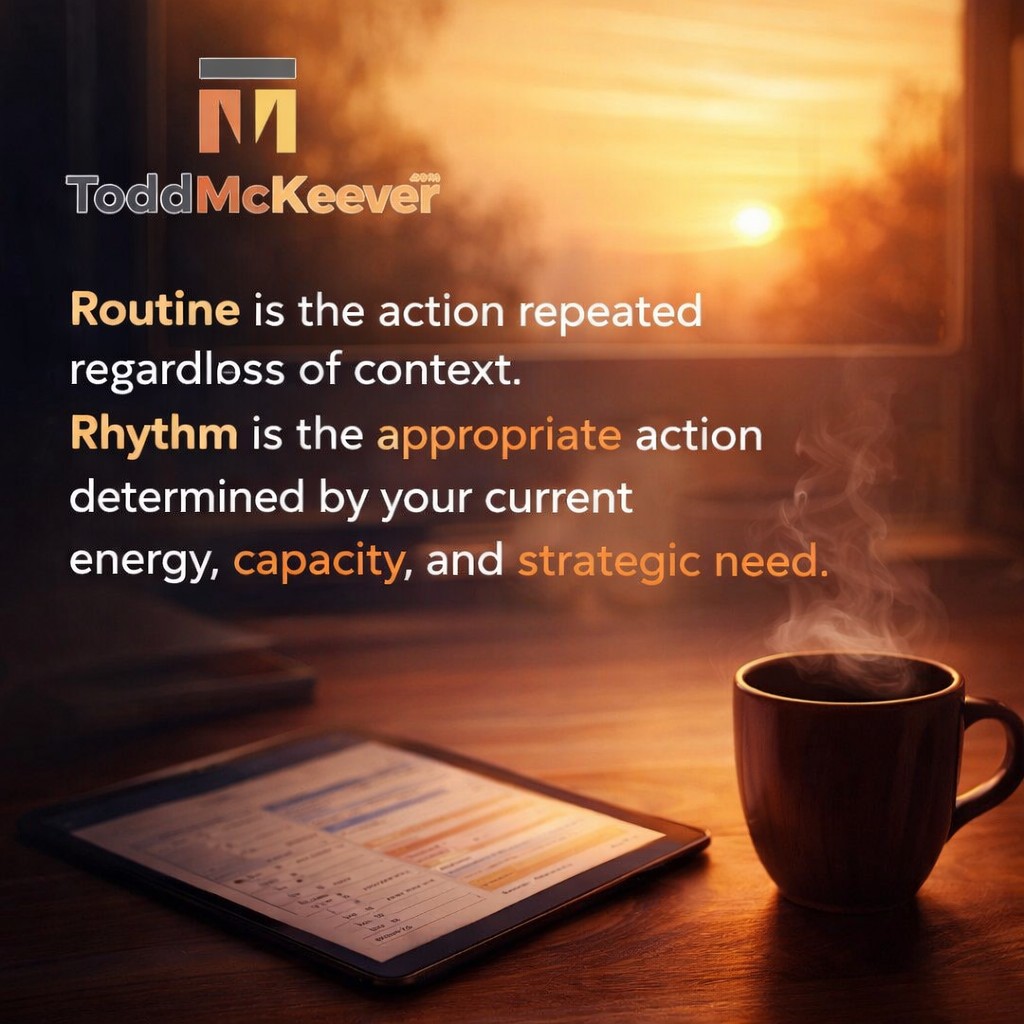
Routine is the same action repeated at the same time regardless of context. Rhythm is the appropriate action determined by current energy, capacity, and strategic need.
Consequently, routine creates predictability at the cost of adaptability. In contrast, rhythm creates sustainability because it respects human limits and seasonal variation. Therefore, a leadership rhythm framework becomes essential for long-term effectiveness.
The Leadership Rhythm Framework (Three-Part System)
Most leaders structure their days around external demands. Meetings stack. Deadlines loom. Requests accumulate. However, rhythm-focused leaders structure their days around internal capacity. This is the foundation of an effective leadership rhythm framework.
Part 1 – Daily Energy Architecture
You have three types of energy across any day. Moreover, these energy types are not interchangeable. Understanding this distinction transforms how you structure your work.
Creative energy enables complex thinking, strategic work, and original output. This is the energy required for writing strategy documents, designing new systems, or solving novel problems. Furthermore, creative energy is finite and depletes rapidly when used for the wrong work.
Collaborative energy powers meetings, coaching conversations, and decision-making with others. This is relational energy that requires presence, empathy, and the capacity to hold multiple perspectives simultaneously. In addition, collaborative energy peaks at different times than creative energy.
Administrative energy handles email, logistics, and routine execution. This is the lowest-grade energy that still produces valuable work. Consequently, administrative energy is what remains after creative and collaborative energy are depleted.
The trap: You cannot do creative work effectively when you are in collaborative mode. Similarly, administrative tasks drain creative energy faster than they should because you are using the wrong tool for the job. Therefore, misalignment between energy type and work type creates unnecessary exhaustion.
The leadership rhythm framework application:
Map your natural energy across the day. When is creative energy highest? Typically, this is early morning for most leaders. When does collaborative energy peak? Often midday when you are fully awake but not yet depleted. When is administrative energy all you have left? Usually late afternoon.
Then align your work to match. Consequently, creative work happens when creative energy is available. Meetings happen when collaborative energy is present. Email gets the administrative energy window. This is not about optimization for its own sake. Rather, this is about respect for how humans actually function over decades of work.
Part 2 – Weekly Seasonal Variation
Your weeks have seasons just like years do. Moreover, ignoring this seasonal variation is a primary cause of mid-career burnout.
Monday-Tuesday: Strategic Season – Energy is highest early in the week. Schedule your most important strategic work here. Protect these mornings fiercely.
Wednesday-Thursday: Collaborative Season – Relational energy peaks midweek. Schedule stakeholder meetings, coaching conversations, and cross-functional alignment here.
Friday: Integration Season – Energy is lower by the end of the week. However, reflective capacity is actually higher. Use Friday for review, planning next week, and wrapping incomplete work.
Part 3 – Monthly Rhythm Cycles
Even your best weeks exist within larger cycles that require different modes of operation. Some months demand intense external focus. In contrast, other months need internal focus. Leaders who try to maintain the same leadership rhythm framework across different monthly demands create unnecessary friction.
The Mid-Career Tradeoff
It requires giving up the myth that you can be infinitely flexible. Early-career leaders survive on adaptability. Mid-career changes this. You have proven competence. Therefore, you can protect your creative energy.
The specific tradeoff: You choose sustainable decades of performance OR you choose infinite availability in the moment. You cannot have both.
How to Build Your Leadership Rhythm Framework
Start with energy mapping – Track your energy for two weeks without changing anything.
Then build protection systems – Once you know your patterns, protect them ruthlessly.
Finally, audit monthly – Review what worked and what created friction.
The Thing Beneath the Thing
Rhythm is not a productivity hack. Rhythm is how you sustain performance for decades instead of years. The difference between routine and rhythm is the difference between compliance and intelligence.
P.S. Want frameworks like this delivered to your inbox every week? Subscribe to my newsletter at toddmckeever.com
Stay in the work
Join Free
Join free for Tuesday teaching that helps you see what is happening and all the free content. Public writing remains open without an email.