Field note · December 14, 2025
Leadership Systems That Work Don’t Start With Efficiency
By Todd McKeever
You’ve built leadership systems before.
Task management. Communication protocols. Decision frameworks. Meeting rhythms.
And if you’re honest, most of them died within six weeks.
Not because you lacked discipline. Not because the system was poorly designed.
But because the system was built for someone else’s rhythm, someone else’s leadership style, someone else’s version of success.
Here’s what I’ve learned after decades of building, breaking, and rebuilding systems: The systems that actually work aren’t about efficiency. They’re about alignment.
And until you understand that distinction, you’ll keep building systems that quietly suffocate the very leadership they were meant to support.
The Central Truth:
Most leaders approach systems backwards. They start with the question “How can I do more?” when they should start with “What does my leadership actually need to sustain?”
Systems fail when they’re built to maximize output. They succeed when they’re built to protect rhythm.
The Reframe:
Think about the systems you’ve abandoned. The morning routine that lasted three days. The project tracker that became digital clutter. The communication protocol your team ignored after the first week.
They failed because they demanded you become someone you’re not.
Efficient? Yes. Sustainable? No.
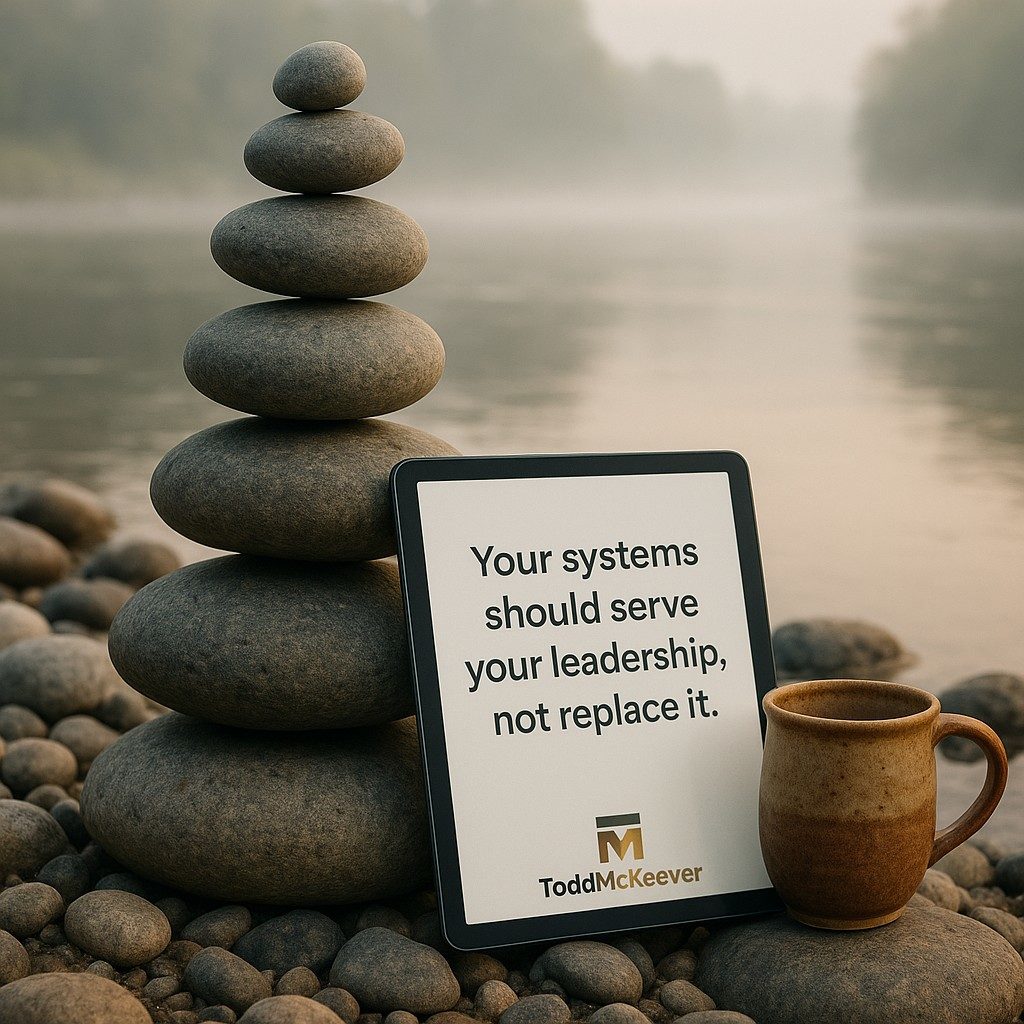
Here’s the shift: Your systems should serve your Leadership Alignment Compass, not replace it.
Remember the Compass? Clarity. Vision. Rhythm. Execution.
Every system you build should answer one question: Which of these four does this protect?
The Framework: The Four-Question System Audit
Before you build (or rebuild) any leadership system, run it through these four questions:
- Does this system protect my clarity?
Clarity systems eliminate decision fatigue for the things that don’t matter so you have mental bandwidth for the things that do.
Examples:
- A morning routine that’s identical Monday through Friday
- A default meeting structure that eliminates “how should we run this?” every time
- Pre-written email templates for recurring requests
If your system forces you to think about low-stakes decisions, it’s stealing clarity.
- Does this system serve my vision?
Vision systems ensure you’re making progress on what actually matters, not just what’s urgent.
Examples:
- A weekly review that tracks progress on your three-year goals, not just this week’s tasks
- A quarterly calendar audit that measures time allocation against stated priorities
- A project filter that rejects anything not aligned with your core leadership focus
If your system doesn’t help you say no to good opportunities for great ones, it’s not serving vision.
- Does this system match my rhythm?
Rhythm systems work with your natural energy patterns, not against them.
Examples:
- Deep work blocks scheduled during your peak cognitive hours
- Communication windows that batch interruptions instead of scattering them
- Recovery rhythms built into your week, not squeezed in when you’re burnt out
If your system requires willpower to maintain, it’s fighting your rhythm.
- Does this system enable better execution?
Execution systems reduce friction between decision and action.
Examples:
- A task capture method that takes less than 10 seconds
- A delegation protocol that doesn’t require you to re-explain context every time
- A file organization structure where you can find what you need in under 30 seconds
If your system makes simple tasks complicated, it’s sabotaging execution.
The Story: My Own System Failure
Three years ago, I built what I thought was the perfect leadership system.
Every morning: review goals, plan the day, journal insights. Every Sunday: weekly review, plan the week ahead. Every quarter: strategic retreat, vision alignment, goal recalibration.
On paper? Flawless.
In reality? I lasted five weeks.
The problem wasn’t the components. The problem was that I’d built a system for the leader I thought I should be, not the leader I actually was.
I’m not a daily goal reviewer. I’m a rhythm thinker. I don’t need to see my three-year vision every morning. I need to trust that my weekly rhythm is moving me toward it.
So I rebuilt. Smaller. Simpler. Aligned.
Now my system has three components:
- A Monday morning clarity review (30 minutes)
- A Friday afternoon momentum check (15 minutes)
- A quarterly alignment audit (2 hours)
That’s it.
And it’s worked for three years because it matches how I actually lead, not how productivity leaders told me I should.
The Practical Application
Here’s how to build a system that won’t fail you:
Step 1: Audit what you’ve already abandoned
List the last three systems you tried to implement that didn’t stick. For each one, identify which part of the Compass it was trying to serve and why it failed. The pattern will tell you where your real need is.
Step 2: Start with rhythm, not efficiency
Don’t ask “What system will help me do more?” Ask “What system will help me sustain my best leadership without burning out?” Build from there.
Step 3: Design for your worst week, not your best
If your system only works when you’re rested, motivated, and ahead of schedule, it’s not a system. It’s a fantasy. Build something that functions when you’re tired, distracted, and behind.
Step 4: Make it ridiculously simple
The best systems have three components or fewer. If you can’t explain your system in one sentence, it’s too complex.
Step 5: Test for 30 days, then adapt
Don’t judge a system in week one. Give it a month. Then ruthlessly edit based on what actually happened, not what you wish happened.
The Pivot
Here’s what’s interesting.
When you build systems that actually align with your leadership rhythm, something unexpected happens.
You stop needing most of the systems you thought were essential.
Because aligned systems don’t multiply. They simplify.
One good clarity system eliminates the need for five productivity hacks. One strong rhythm system replaces a dozen time management techniques.
The leaders who seem effortlessly effective aren’t running more systems. They’re running fewer systems that actually work.
The Coach’s Insight
“A leadership system isn’t about doing more with less. It’s about doing what matters without the mental tax of figuring out how every single time.”
That’s the difference between efficiency and alignment.
Efficiency asks: How can I optimize this?
Alignment asks: Does this even belong in my leadership?
Most of the systems you’re struggling to maintain are solving problems you shouldn’t be carrying in the first place.
Closing Thought
You don’t need a better system.
You need a system that’s actually yours.
Built for your rhythm. Aligned with your vision. Designed for the leader you are, not the leader productivity culture tells you to become.
So before you download another template, adopt another framework, or commit to another 30-day challenge, ask yourself:
Is this system serving my leadership, or am I serving the system?
Because the moment you can answer that honestly, you’ll stop building systems that fail and start protecting the rhythm that makes your leadership sustainable.
Call-to-Action
If you’re ready to build systems that actually match your leadership rhythm, join free to unlock the Leadership Alignment Compass. It’s the framework that helps you identify where your systems need to serve Clarity, Vision, Rhythm, or Execution so you stop building what sounds good and start building what works.
Download the Leadership Alignment Compass →
And if you want a weekly dose of 401-level leadership teaching like this, subscribe to my newsletter. Every week, I share frameworks, insights, and resources that help mid-career leaders create momentum without the burnout.
Stay in the work
Join Free
Join free for Tuesday teaching that helps you see what is happening, selected free resources, and the Leadership Alignment Compass. Public writing remains open without an email.