Field note · February 2, 2026
Creating Momentum in Leadership
By Todd McKeever
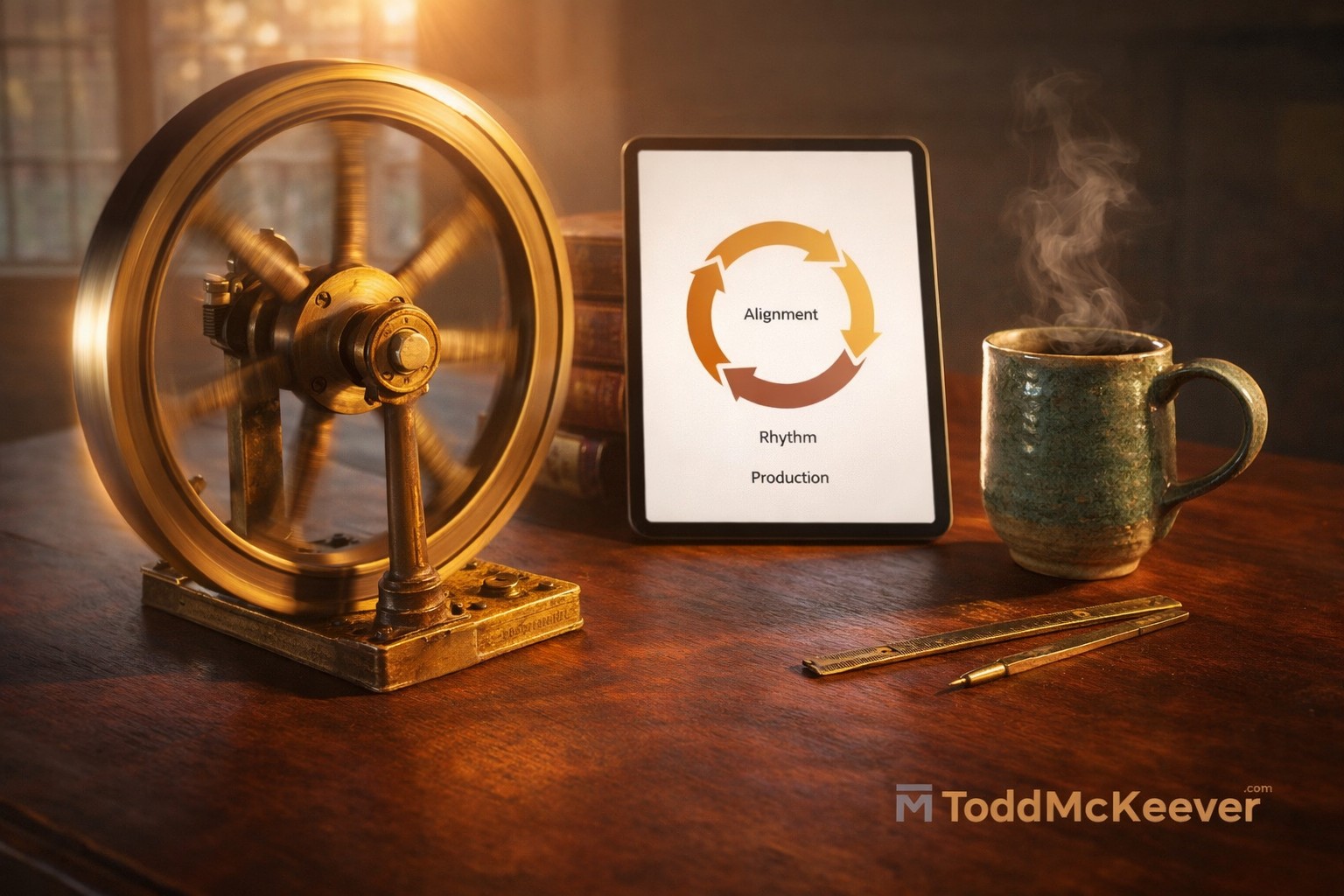
Creating momentum in leadership. You’ve done the work. The late nights. The strategic plans. The team meetings where you rallied everyone around the vision.
And yet, nothing’s moving.
You’re not lazy. You’re not incompetent. You’re experiencing something most mid-career leaders face but few name directly: creating momentum in leadership isn’t about working harder. It’s about understanding what actually generates forward motion at your level.
The skill that got you here won’t get you there. Furthermore, the momentum strategies that worked when you were an individual contributor will actively sabotage you now.
Why Momentum Dies at Mid-Career
I spent fifteen years thinking momentum was about energy. Push harder. Move faster. Create more urgency.
Then I watched a VP of Operations systematically destroy a functioning team by applying exactly that thinking.
She inherited a team with solid systems and decent morale. Within six months, turnover spiked. Projects stalled. The energy in the room felt frantic instead of focused.
The problem? She was creating momentum in leadership the way individual contributors create momentum: through personal effort and tactical execution.
At mid-career, that approach doesn’t scale. In fact, it creates what I call “false momentum”—the appearance of progress that masks systemic stagnation.
Here’s what most leaders miss: momentum at your level isn’t about what you do. It’s about what you enable others to do.
Consequently, the first step in generating real momentum is killing the myth that you’re the one who needs to move faster.
The Momentum Framework for Mid-Career Leaders
Real momentum at mid-career comes from three specific shifts. These aren’t motivational concepts. They’re structural changes in how you operate.
Shift 1 – From Activity to Alignment
When you were an individual contributor, momentum came from completing tasks. Check the box. Ship the feature. Close the deal.
That created visible progress. It felt good. Moreover, it was directly under your control.
But at mid-career, momentum comes from alignment, not activity. Your job is to ensure that the ten people on your team are all pulling in the same direction. Therefore, creating momentum in leadership means building systems that keep everyone synchronized even when you’re not in the room.
Ask yourself: Can your team articulate the top three priorities without looking them up? Can they explain why those three matter more than the other twenty things competing for attention?
If not, you’re generating activity without alignment. That’s not momentum. That’s motion sickness.
Shift 2 – From Speed to Rhythm
Speed feels like momentum. It’s visceral. Urgent. Measurable.
But speed without rhythm is chaos.
I learned this watching a senior director try to “create momentum” by accelerating everything. Shorter sprint cycles. Daily check-ins. Constant status updates.
His team burned out in eight weeks. Meanwhile, projects that should have taken six months took nine because the constant acceleration prevented any sustained focus.
Creating momentum in leadership at mid-career requires rhythm, not speed. Rhythm is the predictable cadence that lets people do deep work without constantly context-switching.
Consequently, sustainable momentum comes from establishing patterns your team can rely on: when decisions get made, when resources get allocated, when strategic direction gets reviewed.
Speed is tactical. Rhythm is structural. You need the latter to generate the former.
Shift 3 – From Proving to Producing
Here’s the uncomfortable truth: you’re still trying to prove yourself.
You’ve been proving yourself for fifteen years. You proved you could execute. You proved you could manage people. You proved you could think strategically.
And now you’re in a role where proving doesn’t create momentum. Producing does.
The distinction matters. Proving is about you. Producing is about outcomes that exist independent of your effort.
Creating momentum in leadership at your level means building systems that produce results even when you’re not actively involved. In addition, it means developing people who can make decisions without asking for permission.
If your team can’t function for three days while you’re on vacation, you haven’t created momentum. You’ve created dependency.
How to Build Momentum That Lasts
Most leaders approach momentum wrong. They look for the one big initiative that will “turn things around.” The new strategy. The reorganization. The culture shift.
But sustainable momentum doesn’t come from big moves. It comes from small, consistent structural changes that compound over time.
Here’s the application framework I use with clients:
- Start with constraint identification. What’s the actual bottleneck preventing momentum? Not what feels urgent—what’s structurally limiting throughput? In most cases, it’s you. You’re the constraint. Therefore, the first move in creating momentum in leadership is removing yourself from the critical path.
- Build decision-making systems. Document the three most common decisions your team faces weekly. Then create clear frameworks for how those decisions should be made without your input. Consequently, you free up cognitive bandwidth for strategic work while empowering your team to maintain momentum independently.
- Establish rhythm anchors. Pick three non-negotiable rhythms: a weekly priority sync, a monthly strategic review, and a quarterly recalibration. These become the structural backbone that keeps momentum from devolving into chaos. As a result, your team knows exactly when strategic direction gets set and when tactical adjustments happen.
Create visible progress markers. Momentum isn’t just about movement—it’s about perceivable progress. Build systems that make progress visible to the entire team. Moreover, make sure those markers reflect outcomes, not just activity.
The key insight? Creating momentum in leadership isn’t about inspiring people to work harder. It’s about building systems that make forward progress the natural default state.
The Truth Beneath the Truth
The leaders who struggle with momentum aren’t failing because they lack drive or vision. They’re failing because they’re applying individual contributor logic to systemic problems.
You can’t personally execute your way to organizational momentum. You can’t hustle your way to sustainable progress. Furthermore, you can’t motivate your way past structural dysfunction.
Creating momentum in leadership at mid-career requires a fundamental shift in self-concept. You’re no longer the person who does the work. You’re the person who builds the systems that enable the work to happen.
That’s not less important. It’s more important. But it requires letting go of the identity that got you here: the person who could always outwork the problem.
The real work of mid-career leadership is building something that generates momentum without requiring your constant intervention. Consequently, legacy isn’t what you accomplished. It’s what kept moving after you stepped away.
Closing
Most mid-career leaders are exhausted because they’re trying to create momentum through personal effort. That worked when you were an individual contributor. At your level, it’s structural malpractice. Creating momentum in leadership means building systems, establishing rhythms, and removing yourself from the critical path. The momentum you generate without touching anything directly is worth more than anything you could accomplish personally.
P.S. Want frameworks like this delivered to your inbox every week? I break down advanced leadership systems every Tuesday in my free newsletter. No fluff. All substance. Subscribe.
Stay in the work
Join Free
Join free for Tuesday teaching that helps you see what is happening and all the free content. Public writing remains open without an email.